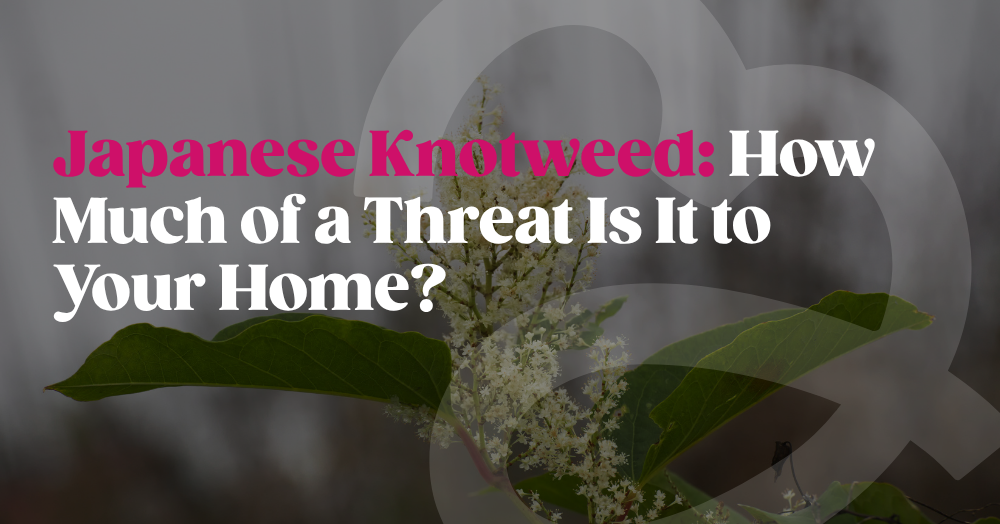
Japanese Knotweed: How Much of a Threat Is It to Your Home?
Few plants have a reputation quite like Japanese knotweed.
Mention it during a house sale and it's easy to imagine damaged foundations, nervous mortgage lenders and a property becoming almost impossible to sell.
But while Japanese knotweed is certainly invasive and needs to be taken seriously, the reality is more balanced than some of the headlines over the years might have been suggested.
Research and updated guidance from the Royal Institution of Chartered Surveyors (RICS) have changed the way Japanese knotweed is assessed. Today, the focus is much more on the actual impact of the plant on a property, rather than simply how many metres away it happens to be.
So, if you're buying or selling a home in Hull, East Yorkshire or the surrounding villages, what do you actually need to know?
What is Japanese knotweed?
Japanese knotweed is a fast-growing invasive plant that was introduced to Britain during the 19th century.
One of the reasons it is so difficult to control is the way it spreads. New growth can develop from very small pieces of its underground rhizome system, which means cutting or disturbing the plant without knowing what you're doing can actually make the problem worse. Government guidance says a new plant can grow from rhizome fragments as small as 1cm.
It can grow quickly, overwhelm other vegetation and cause problems around developed land.
But the idea that knotweed will automatically punch through the foundations of a house and cause major structural damage is not an accurate picture of every infestation.
Can Japanese knotweed damage a house?
It can cause damage, but the level of risk depends heavily on where it is growing and the condition of the structures around it.
Research considered by RICS found that Japanese knotweed does not present the exceptional structural threat it was once thought to. RICS notes that substantial residential structures were not generally being damaged simply because knotweed was growing nearby.
That doesn't mean it should be ignored.
Japanese knotweed can still cause problems with things such as:
- Garden walls and other structures with relatively shallow foundations
- Patios, paving and pathways
- Conservatories and lightweight outbuildings
- Gardens and usable outdoor space
- Drains and underground services in some circumstances
The key difference in today's approach is that surveyors look at what the knotweed is actually doing, rather than treating every sighting as the same level of threat.
Has the seven-metre Japanese knotweed rule changed?
Yes.
This is one of the biggest changes homeowners need to be aware of.
For years, Japanese knotweed was assessed using what became known as the seven-metre rule. Its presence within seven metres of a property could trigger additional concerns during a valuation or mortgage application. That system is no longer current.
RICS introduced a new professional standard in 2022, replacing the old approach with an assessment based primarily on the knotweed's impact on the property.
For knotweed growing on neighbouring land, the relevant distance in the current RICS assessment is generally three metres from the property's boundary, rather than seven metres from the home.
That's quite a significant shift.
How is Japanese knotweed assessed now?
Under the current RICS approach, Japanese knotweed is placed into four management categories.
Management Category A: Action
Knotweed is present and causing visible material damage to a significant structure. Specialist advice and action are needed.
Management Category B: Action
The plant isn't causing visible structural damage, but its growth is likely to restrict the use of or access to part of the property's amenity space.
Management Category C: Manage
Knotweed is present on the property but isn't causing damage or significantly affecting the use of the outside space. For lending purposes, RICS says this is considered a lower-impact situation.
Management Category D: Report
Knotweed is visible on neighbouring land within three metres of the property's boundary. The surveyor reports it, although RICS says a mortgage retention would not normally be expected purely on this basis except in unusual circumstances.
It's a much more practical approach than automatically assuming that knotweed close to a house means major structural damage.
Can you get a mortgage on a property with Japanese knotweed?
Potentially, yes.
Finding Japanese knotweed doesn't automatically mean that a property is unmortgageable.
Individual mortgage lenders have their own criteria, so the exact response will depend on the circumstances, the surveyor's findings and the lender involved.
Where the knotweed is considered to have a more significant impact, a lender may want to see a specialist report and appropriate management plan before agreeing to lend.
The current RICS framework was designed partly to give valuers and lenders a more proportionate way of assessing these situations rather than treating every infestation in exactly the same way.
If you're buying a property where knotweed has been identified, getting the details early can make a real difference.
Knowing its location, the extent of the growth and whether a professional treatment plan is already in place gives your solicitor, surveyor and mortgage adviser something concrete to work with.
Selling a house with Japanese knotweed
If you're selling your home, Japanese knotweed shouldn't simply be ignored or hidden.
The current TA6 Property Information Form asks sellers about Japanese knotweed. Sellers are expected to answer the form truthfully, completely and as accurately as they can based on their own knowledge.
Importantly, that doesn't mean every homeowner is expected to suddenly become a Japanese knotweed expert.
The Law Society acknowledges that it can be difficult to be certain whether knotweed is present, particularly because its underground rhizomes can remain even when nothing is visible above the surface. This is why "not known" can be an appropriate answer where the seller genuinely does not know.
However, if you know that Japanese knotweed is or has been present, that information needs to be dealt with properly.
If you already have a professional survey, treatment programme or management plan, this information can also be provided during the conveyancing process.
Trying to hide a known problem is very different from genuinely not knowing whether the plant is present, so speak to your conveyancer if you're unsure how to answer the relevant questions.
What if you're buying a house with Japanese knotweed?
First of all, don't automatically panic.
A report of Japanese knotweed doesn't necessarily mean you need to walk away from the house.
Instead, establish exactly what has been found.
- Where is the plant?
- Is it actually within the property's boundary?
- Is it causing any damage?
- Is it affecting the use of the garden?
- Is there already a professional treatment or management programme in place?
These details are far more useful than simply hearing the words "Japanese knotweed".
A surveyor can identify concerns during the buying process, while a specialist invasive-weed contractor can provide more detailed advice on the extent of an infestation and the most appropriate treatment.
Your mortgage adviser should also be made aware so that any lender requirements can be considered before you get too far into the transaction.
Can you remove Japanese knotweed yourself?
This is one area where a DIY approach can cause more problems than it solves.
Government guidance states that you do not automatically have a legal obligation to remove Japanese knotweed simply because it is growing on your land. However, you do need to prevent it from spreading off your property, and causing it to spread into the wild can lead to prosecution. Contaminated plant material and soil may also be treated as controlled waste.
Because even small rhizome fragments can create new growth, simply cutting it down, digging around it or putting it into normal garden waste is not the answer.
The Property Care Association recommends obtaining professional advice and has an Invasive Weed Control Group whose members can survey infestations and produce appropriate management plans.
How is Japanese knotweed treated?
There isn't one treatment that is right for every property.
Depending on the location and severity of the infestation, options can include longer-term herbicide programmes or excavation and removal.
For many residential properties, the Property Care Association says a herbicide treatment and ongoing management programme is the most common and cost-effective option.
That can involve treatment over several growing seasons, followed by monitoring for further growth.
This is another reason why professional advice matters.
The aim isn't simply to make the visible plant disappear. It is to manage the underground rhizome system and reduce the risk of regrowth or further spread.
Does Japanese knotweed reduce the value of a property?
It can affect a property's value or saleability, but there isn't a standard amount that every affected home loses.
Its impact will depend on factors including the extent and location of the infestation, whether it is affecting structures or garden space, the cost of treatment, whether a management plan is already in place and how potential buyers and lenders respond.
The newer RICS approach recognises that an infestation causing structural damage shouldn't be treated in the same way as a small area of knotweed that isn't affecting the house or how the garden can be used.
That's why professional advice and accurate information are so important when valuing or marketing an affected property.
Japanese knotweed isn't necessarily the end of your move
Japanese knotweed deserves to be taken seriously.
But finding it doesn't automatically mean your home is unsellable, that a buyer won't be able to obtain a mortgage or that the building is being destroyed underneath you.
Our understanding of the plant has moved on significantly.
The modern approach is about identifying where it is, what impact it is actually having and how it can be professionally managed.
So, whether you're selling a property where Japanese knotweed has been identified or you're buying a home and it appears on your survey, don't let the name alone make the decision for you.
Get the facts, speak to the right specialists and understand exactly what you're dealing with.
Your Best Move Yet
Whether your next move involves a new kitchen or a new set of keys, it pays to understand your options first.
If you're considering selling your home in Hull, East Yorkshire or the surrounding villages, speak to your local Beercocks team for straightforward advice and a no-obligation property valuation.
We'll help you understand what your home could be worth and what your next move might look like.
#Beercocks