Estate Agent Fees: Fixed Fees vs Commission Explained
Compare fixed estate agent fees and commission, including VAT, contracts and what’s included. Understand which option could offer better value when selling.
Estate Agent Fees: Fixed Fees vs Commission
Estate Agent Fees: Fixed Fees vs Commission How Do Fixed Estate Agent Fees Work?
A fixed-fee estate agent charges an agreed amount for marketing and selling your property. The fee doesn’t normally change according to the price eventually achieved.
Fixed fees are commonly associated with online or DIY estate agents, although some traditional agents also offer them. Depending on the agency, you may have to pay before your property is marketed, after an agreed deferral period or when the sale completes.
An upfront fee can initially look attractive because it’s usually lower than the commission charged by a full-service estate agent. However, an upfront payment may remain payable even if the property doesn’t sell.
The service included can also vary considerably. A basic fixed-fee package might include a portal listing and photographs, while viewings, premium listings, floorplans, sales progression or negotiation support could cost extra.
Before instructing a fixed-fee agent, find out:
● Whether the fee is payable upfront or can be deferred
● Whether the fee is refundable if the property doesn’t sell
● How long your property will remain advertised
● Which property portals will carry the listing
● Whether photography and a floorplan are included
● Who will conduct viewings
● Whether the agent will qualify prospective buyers
● Who will negotiate offers and progress the sale
● Whether withdrawing the property creates an additional charge
● Whether deferred payment is connected to a particular conveyancer or financial product
A fixed fee gives you certainty over the agent’s initial charge, but it doesn’t necessarily give you certainty over the complete cost of selling.
How Does Estate Agent Commission Work?
A commission-based estate agent charges an agreed percentage of the property’s final selling price. Many traditional agents work on a no-sale, no-fee basis, meaning their commission only becomes payable if the transaction completes.
Because the fee is linked to the selling price, the agent has a financial reason to negotiate the strongest achievable result. They also need to keep the transaction moving because an accepted offer doesn’t generate a fee if the sale subsequently falls through.
For example, a fee of 1% on a £200,000 sale would be £2,000 before VAT. If VAT is added at 20%, the total would be £2,400. Sellers should always compare VAT-inclusive figures rather than assuming the percentage shown represents the complete charge.
Commission-based fees may include:
● An in-person property valuation
● Advice on pricing and preparing the property
● Professional photography
● Floorplans and property descriptions
● Listings on major property portals
● Marketing to registered buyers
● Social media and other digital promotion
● Enquiry management and accompanied viewings
● Feedback following viewings
● Buyer qualification
● Offer negotiation
● Liaison with buyers, solicitors and other agents
● Sales progression through to completion
Not every commission-based package includes precisely the same services, so ask each agent to explain their approach and put the agreed terms in writing.
Fixed Fee vs Commission: Comparing the Differences
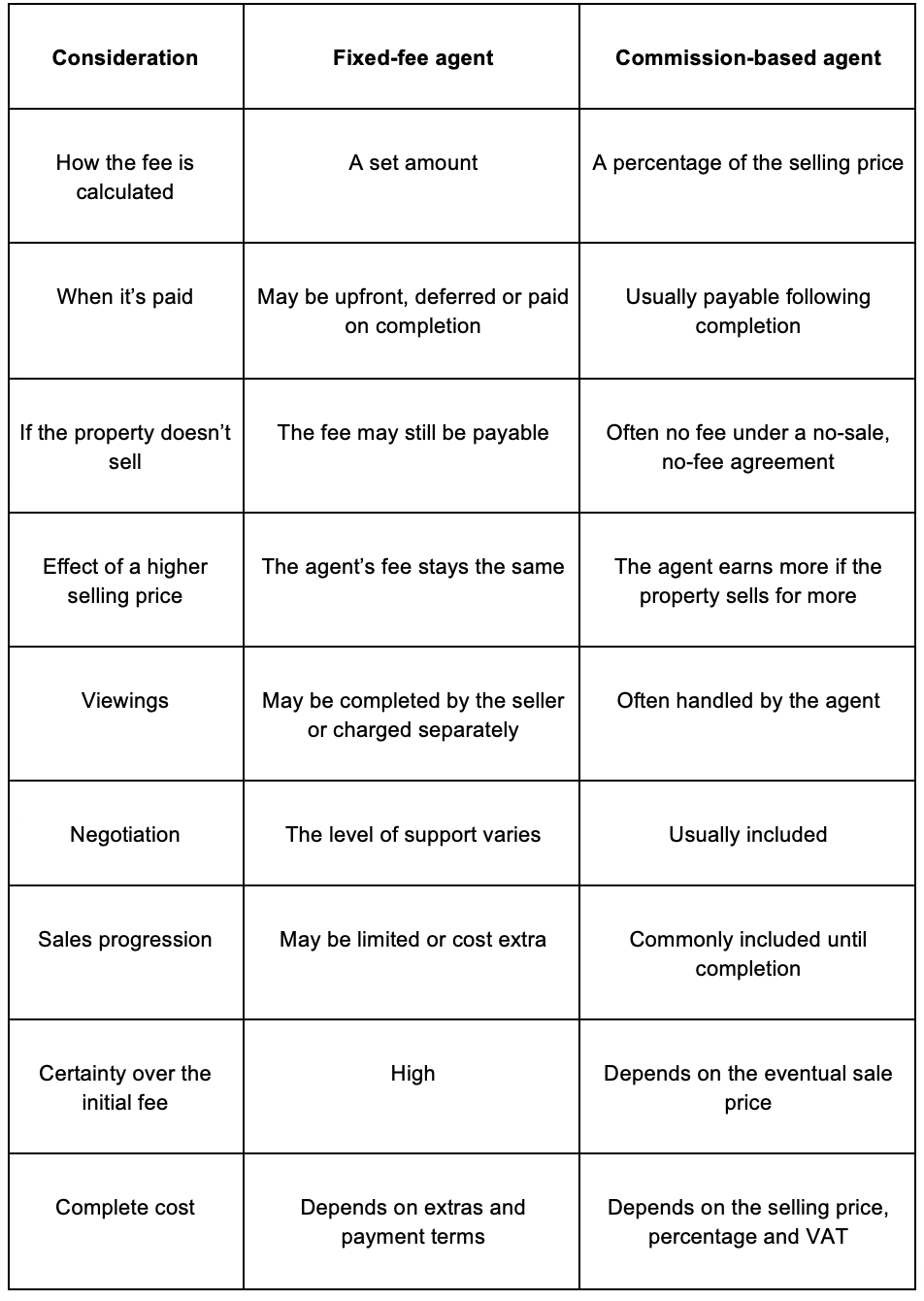
These are general differences rather than rules. Always compare the individual service and contract you’re being offered.
Does a Lower Estate Agent Fee Save You Money?
Sometimes it will. If two agents are likely to achieve the same price and provide the same service, the agent charging less would leave you better off.
But that isn’t always how property sales work.
Suppose one agent charges £1,000 upfront and another charges £2,400 following completion of the sale. The fixed-fee option initially appears to save £1,400. However, if the full-service agent achieves several thousand pounds more through better presentation, stronger buyer demand or more effective negotiation, the higher fee could still produce the better financial result.
The final selling price isn’t the only consideration. A good agent can also help reduce the risk of a sale falling through by checking a buyer’s circumstances, maintaining communication and dealing with delays across the chain.
Value should therefore be measured by what you retain after the transaction, the quality of the support and the likelihood of reaching completion - not just the number printed next to “agent’s fee”.
What Should Be Included in an Estate Agent’s Fee?
A quotation should make it clear what you’re paying for and whether anything will be charged separately.
Ask what the agent will do to create demand for your property. Taking photographs and placing the home on a property portal is just one part of this process. The estate agent should also be able to explain how and why the asking price has been established, which buyers they’ll contact, how they’ll manage enquiries and what they’ll do if the initial marketing doesn’t produce the desired response you’re looking for.
You should also get an idea of who’ll conduct viewings and negotiate any offers. If the agent receives several offers, will they pass them on, or will they investigate each buyer’s position and help you compare so you can come to a conclusion on the right offer.
Once you accept an offer, sales progression becomes especially important. The agent may need to communicate with the buyer, seller, mortgage broker, conveyancers and other agents in the chain. A low-cost package offering little support at this stage may leave you managing much of that communication yourself.
Check the Estate Agency Contract Before Signing
The fee is only one part of the agreement. Read the complete contract and ask the agent to explain anything that isn’t clear.
As experts in the property market in Hull and surrounding areas, we would say to pay particular attention to:
● VAT
Check whether VAT is included in every price and percentage you’ve been quoted. The written agreement should make the total charge clear.
● Sole agency and multi-agency agreements
Under a sole agency agreement, one agent markets the property for an agreed period. A multi-agency arrangement allows more than one agent to look for a buyer, but the fee is usually higher.
“Joint sole agency” and “sole selling rights” have different implications. In particular, a sole selling rights clause might mean a fee becomes payable even if you find the buyer yourself during the agreement.
● Tie-in periods and notice
Find out how long you’re committed to the agent and how much notice you will need to give if you decide to leave. Avoid signing a lengthy agreement unless you’re comfortable with the service, review process and exit terms.
● Withdrawal and marketing charges
Ask whether you’ll pay anything if you withdraw your property, switch agents or decide not to proceed. Photography, Energy Performance Certificates, premium advertising and other services may be included, optional or charged separately.
● Introduced buyers
An agent may remain entitled to a fee if someone they introduced later buys the property. If you change agents, keep records of prospective buyers introduced during the first agreement and make sure both agents understand the position.
● Additional services and referrals
An agent may recommend conveyancers, mortgage brokers or removal firms, so make sure to ask whether you’re actually required to use them, if they cost extra and whether the agent receives a referral fee as a result. You’re not under any obligation to use any third-party services your property agent recommends.
The Property Ombudsman’s residential estate agency code provides further information about expected standards, written agreements and consumer protection.
How to Compare Estate Agents Properly
Invite more than one agent to value your home, but this doesn’t mean you should automatically choose the highest valuation or lowest fee; some agents may just want a quick sale to get their commission so may suggest a lower valuation to begin with. However, an unrealistic asking price can leave a property sitting on the market and eventually lead to reductions.
Ask each agent the following questions:
● What evidence supports the recommended asking price?
● Which comparable properties have they sold locally?
● Who’s most likely to buy your property?
● How will they reach buyers beyond the major portals?
● Who’ll conduct viewings and provide feedback?
● How will offers be assessed and negotiated?
● What happens after an offer is accepted?
● How frequently will you receive an update?
● What’s included in the fee?
● Is VAT included?
● What’s the tie-in period and notice requirement?
● What will you owe if the property doesn’t sell?
You can also read our guide to common property valuation myths before deciding which valuation and marketing recommendation to accept. As well as this we’d also suggest doing your own research at local and similar properties to yours that have been sold in the recent years to get a good baseline understanding of where your property sits in the market.
Is a Fixed Fee or Commission Better?
A fixed fee may suit you if you’re comfortable conducting viewings yourself as well as managing enquiries and taking a more active role in the transaction. It can also provide a predictable initial cost.
Commission may be more suitable if you want a full-service agent with a direct financial interest in achieving a strong sale price and reaching completion.
The important question isn’t simply, “Which agent charges less?” It should be more geared towards “Which agent is most likely to achieve the best overall outcome for my property?”
Compare the marketing, local knowledge, negotiation, communication, contract and sales progression alongside the fee. A small saving at the beginning can prove expensive if the property is poorly presented, incorrectly priced or left without proper support once a buyer is found.
Estate Agent Fee FAQs
Q: Do estate agent fees include VAT?
A: Not always in the initial percentage someone mentions verbally, so check the written quotation. Ask for the complete VAT-inclusive amount or percentage before signing the agreement.
Q: Do I pay an estate agent if my house doesn’t sell?
A: It depends on the contract. Under many no-sale, no-fee commission agreements, the selling fee isn’t payable if the transaction doesn’t complete. An upfront fixed fee may still be payable even if no buyer is found. You may also have separate charges for marketing, withdrawal or other services, such as solicitor fees, so make sure to check all documentation so you know what to expect.
Q: Can I negotiate estate agent fees?
A: Some agents will discuss their fee, but the cheapest percentage shouldn’t be considered in isolation. If a reduction also means fewer services, limited marketing or less support, it may not represent better value. However, it’s worth asking, especially if other estate agents have a lower fee with the same services included.
Q: When are estate agent fees paid?
A: Commission is commonly paid from the proceeds of the sale following completion, usually through the seller’s conveyancer. Fixed fees may be paid upfront, after a deferral period or on completion. The contract should explain exactly when payment becomes due.
Q: Are online estate agents cheaper than high-street agents?
A: Their headline fees are often lower, but the services aren’t always directly comparable. Check whether viewings, negotiation, buyer qualification and sales progression are included, and whether the fee remains payable if your property doesn’t sell.
Find Out What Your Property Could Achieve
If you’re thinking about selling in Hull, Beverley or the surrounding East Yorkshire and North East Lincolnshire areas, start with an informed appraisal of your home.
Book a free face-to-face property valuation and speak to your local Beercocks team about pricing, marketing and the support included throughout your entire sale.